
7 Best Screen-Free Science Activities for Kids
Discover 7 engaging screen-free science activities for kids. Hands-on learning with fossils, geodes, and minerals keeps children curious and away.
Discover 7 engaging screen-free science activities for kids. Hands-on learning with fossils, geodes, and minerals keeps children curious and away.

Last Updated: September 23, 2026
Kids spend an average of seven hours daily on screens, losing time to curiosity and discovery. Screen free science activities flip that equation, turning living rooms into laboratories and backyards into geological exploration.
When kids crack open a geode or sift through fossil-filled sand, they develop critical thinking skills, observation techniques, and confidence from solving real problems without screen guidance.
The best screen-free science activities teach through discovery rather than instruction. A child watches quartz crystals sparkle inside a geode they just cracked open, that moment of surprise is where learning sticks. This guide covers proven activities for kids ages 5-12 and how to choose the right kits for your child's age.
Cracking open a geode is like treasure hunting. Each looks like an ordinary rock until a hammer reveals glittering quartz crystals inside, something real, unique, and millions of years old.
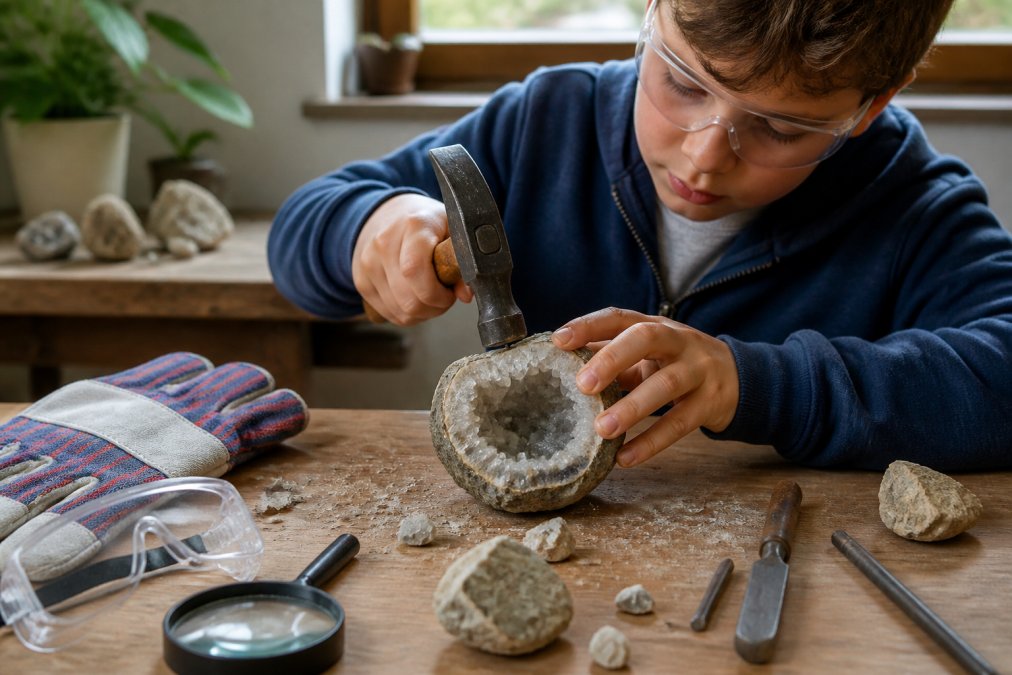
Geodes combine sensory play with scientific learning: anticipation teaches hypothesis formation, cracking engages fine motor skills, crystal observation introduces mineralogy, and keeping a real specimen creates lasting geological connection.
Start with the right materials. You'll need uncracked geodes, a hammer, eye protection, and a safe work surface. The American Academy of Pediatrics guidance on safe play activities recommends adult supervision for any activity involving tools or impact, so set up a designated cracking station where you can oversee the process.
Buried treasure's Cuties line offers smaller geodes, while the gallon-sized Bucket works for older kids and groups.

Setup takes 10 minutes: lay newspaper, place the geode in a bag or towel, and ensure safety glasses are worn. Cracking takes 5-15 minutes depending on geode size.
Before cracking, ask: What do you think is inside? How big are the crystals? What color might they be? These questions form a hypothesis based on exterior observation.
Then the child applies force, observes, and adjusts technique. Finally: What was inside? How does it compare to your prediction? What did you learn about geode formation?
Fossil mining shifts focus to paleontology. Kids sift through sand containing real fossils, trilobites, ammonites, shark teeth, petrified wood, teaching history, evolution, and deep time.
A fossil mining bucket contains dozens of specimens in washed sand. Kids use brushes and tools to carefully expose each fossil, teaching patience and mirroring real paleontological work.
Buried treasure's 1 Gallon Fossil Mining Bucket includes bivalve clams, trilobites, shark teeth, and ammonites, real fossils from millions of years ago. The variety keeps engagement high across multiple sessions.

Real learning begins when a child asks: What is this? How old is it? Where did it come from? These questions lead to research and hypothesis testing about different species and time periods.
Fossil mining teaches slow, careful observation. Unlike screen-based learning, it requires patience, gently brushing sand, noticing patterns, piecing together details. This builds sustained attention that screens erode.
The Smithsonian's fossil identification guide provides free resources for identifying common fossils. Pairing a mining bucket with access to identification tools transforms the activity from simple play into genuine learning. A child becomes a junior paleontologist, not just someone playing in sand.
The Dinosaur Mining Bucket combines authentic fossilized dinosaur bone with carved dinosaur figures, a crackable geode, and tumbled stones in gem-fetti sand.

The multisensory appeal keeps engagement high: kids excavate authentic dino bone from the Jurassic and Cretaceous periods while playing with dinosaur figures, combining real paleontology with imaginative play.
After cracking geodes or mining fossils, a collection becomes the foundation for deeper STEM projects developing observation, classification, documentation, and problem-solving skills.
A display cabinet transforms loose specimens into a curated collection, teaching organization and care. A child decides how to arrange specimens: by type, color, size, or origin?
A field journal develops writing, sketching, and observation skills. Each time a child mines a fossil or cracks a geode, they record the date, findings, appearance, origin, and questions.
Screen free science activities work best when they progress in complexity: geode cracking → fossil identification → collection organization → independent research. This builds genuine expertise.
Once a child accumulates rough stones and minerals, sorting teaches fundamental classification based on observable properties.
Geodes teach crystal formation through direct observation, naturally leading to curiosity about geological processes: temperature, pressure, mineral-rich solutions, and time.
Choose kits matched to your child's age and ability. Too advanced frustrates; too simple bores. The sweet spot is slightly challenging, requiring focus and patience with achievable results.
For younger children, prioritize sensory engagement. The Cuties Crack Your Own Geodes kit works well, smaller geodes require less force, and beautiful crystals reward effort.
Older kids handle complex activities requiring sustained focus. The full-size Bucket of Geodes demands technique, figuring out efficient cracking without breaking pieces, keeping them engaged.
Eye protection is essential when cracking geodes. Use a designated work surface. Constant supervision for ages 5-7; available supervision for ages 8-12.
The biggest mistake parents make is treating screen-free science activities as structured lessons rather than exploration. If you turn geode cracking into a worksheet exercise with mandatory observations and sketches, you kill the joy. Let the discovery come first. The learning follows naturally.
| Activity | Age Range | Prep Time | Activity Duration | Supervision Level | Best For |
|---|---|---|---|---|---|
| Crack Your Own Geodes (small) | 5-7 | 10 min | 15-20 min | Constant | Sensory discovery, fine motor development |
| Fossil Mining Bucket | 6-10 | 5 min | 30-45 min | Available | Patience, observation, paleontology interest |
| Dinosaur Mining Adventures | 6-9 | 5 min | 30-60 min | Available | Dinosaur enthusiasm, sensory play with learning |
| Crack Your Own Geodes (large) | 8-12 | 10 min | 20-30 min | Available | Problem-solving, collection building |
| Rough Stone Mining Bucket | 8-12 | 5 min | 45-60 min | Available | Classification, mineral identification |
Hands-on activities like mining buckets, fossil digging, and crystal cracking naturally draw children into scientific exploration. These activities engage curiosity through direct observation and discovery. Start with age-appropriate kits that match your child's interests, provide clear instructions, and allow independent exploration. The tactile experience of uncovering real fossils or cracking geodes creates engagement that screens cannot replicate, making screen-free science feel like play rather than work.
DIY STEM projects for kids include fossil mining with authentic specimens, crystal observation and classification, building mineral displays, and creating field journals to document discoveries. Mining buckets with fossils and geodes teach geology, observation skills, and scientific method. You can also sort minerals by color, hardness, or origin, or examine specimens under magnification. These activities require minimal setup and use real materials rather than simulations.
Hands-on geology activities for students develop critical thinking, fine motor skills, and scientific observation. When children handle real fossils and minerals, they form lasting memories and deeper understanding than passive learning provides. They learn to ask questions, form hypotheses, and test ideas through trial and error. Geology-based discovery also builds confidence as children identify specimens and understand Earth's history firsthand, creating intrinsic motivation to learn more.
For ages 5-7, choose sensory-focused kits with larger specimens and simpler identification. The CUTIES geode bucket ($26) is perfect for the little ones or adults. For ages 8-12, select kits requiring more observation and classification, like the Fossil Mining Bucket ($70) or Rough Stone Mining Bucket ($65), which develop critical thinking and problem-solving. Always supervise geode cracking with eye protection. Check prep time and cleanup requirements before purchasing to ensure the activity fits your schedule and space.
You don't need a formal lab. Start with a dedicated table or bin for mining activities, basic tools like hammers and magnifying glasses, and authentic specimens from educational science kits for home. Add a field journal for recording observations, a simple identification guide, and containers for sorting minerals by type. Mining buckets contain everything needed for discovery-based learning. Keep the setup simple and organized so children can independently explore, observe, and document their findings without adult intervention for every step.
Your cart is currently empty.
Start Shopping